The Stack Effect: Why 50% of the Air You Breathe Comes from Your Crawl Space
Home air doesn’t come only from windows, doors, or the HVAC system. In many houses, the lowest level supplies a surprising share of what circulates upstairs. A widely used rule of thumb is that up to about half of the first-floor air can originate in the crawl space or basement, depending on how leaky the building is. That’s why crawl space air quality matters more than most people expect.
If you’ve been dealing with musty odors, allergy flare-ups, or clammy floors, the crawl space is often part of the story. The good news is that you can usually reduce that upward flow once you understand what drives it.
What “stack effect” really means
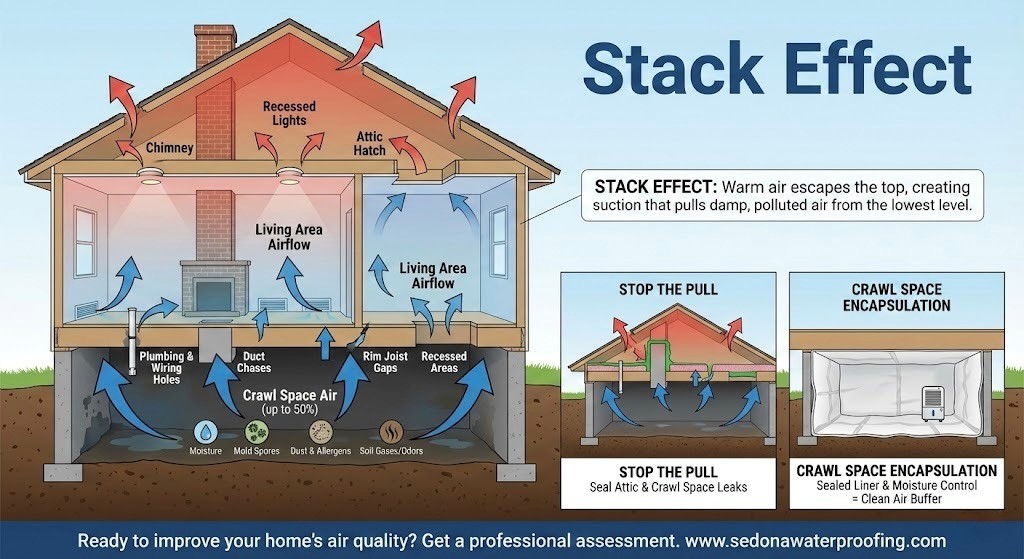
Stack effect is pressure-driven airflow created by temperature differences. Warm air tends to rise, and when it leaks out near the top of a house, lower areas become slightly negative in pressure. That pressure imbalance pulls replacement air in through the easiest openings near the bottom.
Why “50%” comes up so often
The “50%” figure isn’t a universal constant, and it shouldn’t be read as a promise. It’s a practical way to communicate that lower-level air often becomes the make-up air for air that escapes upstairs. In leaky homes, that pathway can dominate, especially during heating season when indoor-outdoor temperature differences are larger.
If you want to know what’s true for your house, testing helps. Blower-door diagnostics and targeted inspections can show where the biggest pressure and leakage points sit.
How crawl space air gets into the rooms you live in
Most crawl spaces connect to the house through more than one route: plumbing openings, wiring penetrations, duct chases, recessed areas under tubs, and gaps at the rim joist. Even if the floor “looks” solid, it rarely acts like an airtight lid.
When air escapes through attic leaks, the home pulls from below. Add bathroom fans, a dryer, or a fireplace, and the suction can increase.
What can ride along with that air
Airflow is only part of the concern. What’s carried in that moving air can affect comfort and health.
Moisture is the usual culprit. Bare soil releases water vapor, and damp foundation surfaces can keep humidity elevated. Higher humidity can lead to condensation in cooler areas and can support microbial growth on wood and insulation.
Particles and odors also travel. Dust, rodent allergens, and that “old basement” smell can migrate upward. In some regions, soil gases are a concern too; pressure differences can draw them into lower levels through cracks and small openings.
Stop the pull by tightening the right places
Many homeowners focus on the crawl space and forget the other half of the loop: where air leaves at the top. If warm air is leaking through attic bypasses, the house will keep pulling from somewhere.
A solid plan usually targets three areas:
- Reduce upper-level leakage (attic hatch, top-plate gaps, penetrations).
- Reduce direct connections between crawl space and living space.
- Control moisture so the air you do pull from below is cleaner and drier.
One of the most cost-effective steps is air sealing crawl space openings around plumbing and wiring, plus the rim joist area, because those gaps often act like open doors for pressure-driven flow.
Crawl space encapsulation as a whole-house upgrade
Encapsulation is often discussed like a single product, but it’s really a package of details: a sealed ground cover, sealed seams, attached edges, and moisture management so the system stays dry.
Building Science Corporation has long recommended a continuous, sealed ground cover to limit moisture migration from soil into crawl spaces. ENERGY STAR’s also stresses that poor sealing at seams and edges can allow ground moisture to leak through gaps, raising crawl space humidity.
Crawl space encapsulation can also make the house feel more even. Less damp air below often means fewer odors and less “cold floor” discomfort. It can also reduce the workload on HVAC equipment when uncontrolled airflow drops.
When mold is part of the picture
Visible growth, persistent odor, or recurring allergy symptoms can point to more than “normal” dampness. If mold is present, cleaning it without fixing moisture and airflow is a short-lived win.
That’s why crawl space mold remediation should be paired with moisture correction, sealing work, and a clear plan to keep humidity down. Done right, the crawl space becomes less of a source and more of a buffer.
Quick checks you can do before calling a pro
A quick look can reveal a lot:
- Check after rain for standing water, wet soil, or staining on foundation walls.
- Look for sagging or damp insulation.
- Notice whether odors are stronger near floor registers or closets on exterior walls.
- Confirm downspouts discharge away from the foundation and that soil slopes away.
If you find water, don’t start by sealing vents and hoping for the best. Handle drainage first, then tighten and control humidity.
Also Read: Crawl Space Waterproofing and Encapsulation: Protecting Your Home from Mold and Structural Damage
Frequently Asked Questions
- What percentage of air comes from a crawl space?
Many home-performance sources cite that up to about 50% of the first-floor air can come from the crawl space or basement, especially in leakier homes and during colder months. The real number varies with attic leakage, duct leaks, weather, and fan use. Testing is the only way to pin it down for one address.
- What is the stack effect of air?
Stack effect is air movement driven by indoor-outdoor temperature differences. Warm indoor air rises and leaks from upper openings. That loss lowers pressure near the bottom, which draws in replacement air through lower leaks and openings. Wind and mechanical exhaust can change how strong it feels, but the basic “low in, high out” pattern remains.
- Why do my floors smell musty when the crawl space is “separate”?
Most floors aren’t airtight. Air can move through wiring holes, plumbing penetrations, gaps at the rim joist, and around ductwork. When air leaks out near the attic, the lower level becomes a make-up air zone. If the crawl space is damp, odors and particles can hitch a ride upward and collect in closets, low-traffic rooms, and near registers.
- Should a crawl space be vented or sealed?
It depends on climate, moisture conditions, and how the home is built, but many modern best-practice guides support closing and conditioning crawl spaces when moisture is managed correctly. In humid conditions, vents can bring in moisture-laden air that condenses on cooler surfaces. A sealed approach usually works best when drainage, ground cover, and humidity control are handled together.
- What is the first fix that usually gives the biggest payoff?
Start outside. Redirect downspouts, clean gutters, and keep water draining away from the foundation. Then address soil moisture and major air leaks. Sealed ground covers and well-sealed seams will help reduce moisture migration. Once bulk water and ground moisture are under control, sealing work and dehumidification become more predictable and effective.