Why Carbon Fiber is the Most Sustainable Choice for Modern Basements in Charlotte NC
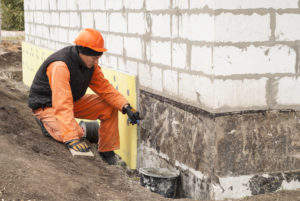
Basement repairs aren’t usually discussed in the language of sustainability, yet the methods chosen below grade affect waste and long-term durability. In Charlotte, basement walls often carry extra side pressure from saturated soils. Carbon fiber foundation repair in Charlotte NC can stabilize a wall with far less demolition than many traditional bracing systems.
Charlotte’s red clay and the slow push on basement walls
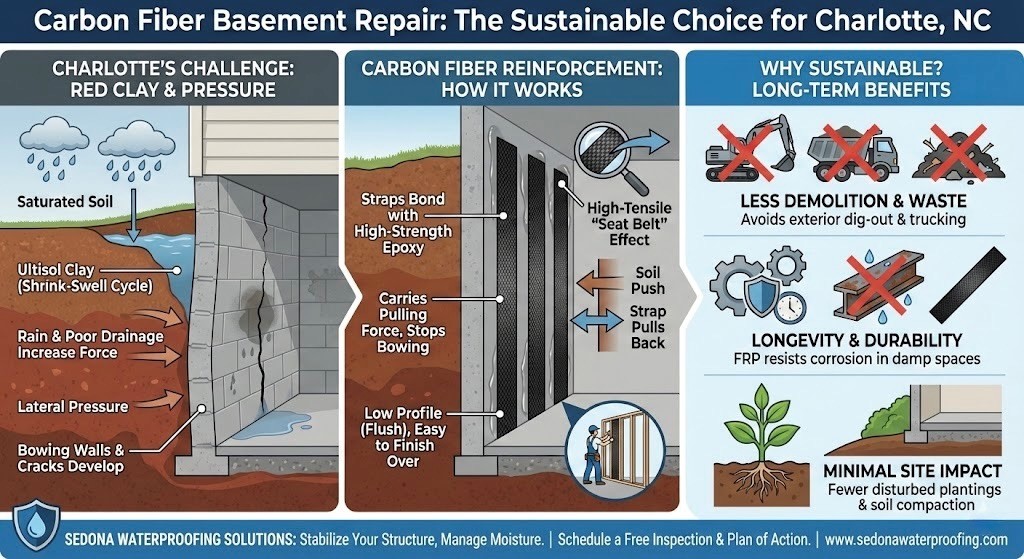
The Charlotte region sits on clay-rich Piedmont soils. The USDA notes that Ultisols, common across the humid Southeast, have a clay-enriched subsoil formed through long weathering and leaching. North Carolina’s Geological Survey explains that shrink-swell clays swell during rainy periods and shrink during drought as moisture content rises and falls.
For basements, that moisture-driven cycle can translate into lateral pressure. Roof runoff that ponds near the foundation and poor surface drainage can keep soil wet for long stretches. Over time, a small crack and a slight inward bow can turn into an obvious curve.
What carbon fiber reinforcement does?
- Carbon fiber reinforcement is a way to keep a basement wall from bending farther inward.
- Installers glue thin carbon fiber straps or a carbon grid to the inside face of the wall using a high-strength epoxy.
- After the epoxy cures, each strap works like a tight seat belt: when soil pressure outside tries to push the wall in, the strap carries the pulling force and helps the wall stay in place.
- Engineers can choose strap size and spacing based on industry standards.
- Because the straps sit nearly flush to the wall, they usually do not steal much basement floor space and make it easier to frame a finished wall later. It stops future movement, but it will not straighten a wall unless paired with other methods.
Why carbon fiber can be the more sustainable repair choice
- Carbon fiber is not a natural material, and its manufacturing can be energy-intensive. The sustainability case in basement repair is mostly about what the method avoids at the house level.
- Experts highlight fiber-reinforced polymer (FRP) for high tensile strength, light weight, and resistance to corrosion compared with many traditional strengthening systems.
- In many Charlotte basements, crews can install straps from inside, which often avoids excavation, trucking, and disposal of soil and damaged concrete. Less digging also means fewer disturbed plantings and less compaction from equipment.
- Longevity is the other piece. Steel bracing can work well, but steel in damp spaces can rust if moisture control slips. FRP systems do not corrode in the same way, which supports long service life in humid basements.
Professional basement structural repair that fits Charlotte homes
Carbon fiber is best for walls that have begun to bow or crack but remain sound enough to stabilize. That calls for measurement, a check of the wall and footing condition, and a plan for water control.
Homeowners needing bowing basement wall repair in Charlotte should also know that straps mainly stop progression. They don’t push a wall back to perfectly plumb unless paired with other corrective systems.
Bottom line
Evaluated systems come with installation rules for surface preparation, epoxy bonding, and strap spacing. A contractor who follows those requirements and addresses drainage at the same time gives the repair its best chance to stay stable.
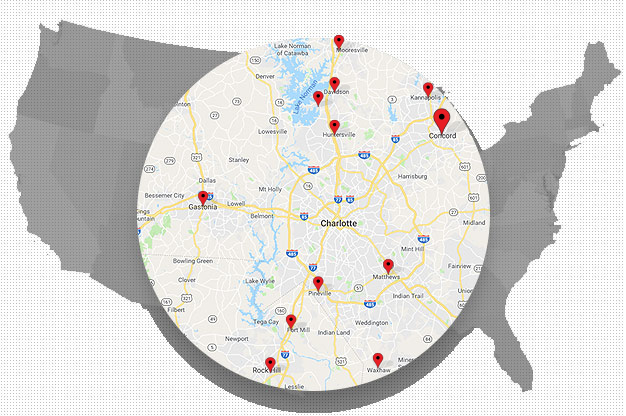
Noticing wall cracks, damp spots, or inward bowing? Contact Sedona Waterproofing Solutions for a free estimate and a clear plan of action. Call 704-960-7906 or use the online contact form to schedule an inspection for Charlotte and nearby communities. We’ll help you stabilize the structure and manage moisture so your basement stays dry, safe, and ready for whatever you want to do with it next.
Frequently Asked Questions
- Is carbon fiber strong enough to fix a bowing basement wall permanently?Carbon fiber composites carry very high tensile loads, and externally bonded FRP systems help strengthen concrete and masonry when designed and installed correctly. The long-term result hinges on the wall’s condition and the installation details: surface prep, epoxy cure, and strap spacing. When the wall is still intact and the pressure source is controlled, the goal is permanent stabilization, meaning the bow stops getting worse.
- Can I finish my basement after a carbon fiber foundation repair?
Most homeowners can. The straps are thin and usually sit tight to the wall, so you can frame in front of them without losing much space. Keep the repair visible until inspections are complete, and consider an access panel for future checks. If finishing is the plan, handle moisture first with proper drainage, a dehumidifier, or waterproofing measures.
- How does Charlotte’s red clay affect my basement’s structural integrity?Clay-rich soils can change volume as moisture changes. North Carolina’s Geological Survey notes that shrink-swell clays swell during rainy periods and shrink during drought as moisture content rises and falls. Across the Piedmont, many soils also have clay-enriched subsoils, which can hold water and add lateral loads against foundation walls when drainage is poor.
- Does carbon fiber fix leaks, too?
No. Straps address structural movement. Water entry needs its own plan, such as crack injection, interior drainage, sump pumping, exterior grading changes, or gutter and downspout upgrades.
- What should I do first when I notice new cracks or bowing?
Start outside: confirm gutters are clear, downspouts discharge away from the home, and the soil slopes away from the foundation. Then schedule a wall evaluation so you know whether carbon fiber, another stabilization method, or broader work is warranted.
Basement wall movement is stressful, but basement repair in Charlotte NC can be practical and responsible at the same time. When carbon fiber fits the wall and the water plan is solid, you get a durable stabilization method that avoids a lot of heavy, wasteful work.