Your Basement is Dry Until it Rains. Here’s What That Really Means
A basement can stay dry for weeks, then one hard rain leaves a dark line along the wall, a wet corner, or a puddle on the floor.
When water shows up only during or after rain, the basement is usually reacting to changing conditions around the foundation. The soil may be saturated. Runoff may be collecting too close to the house. Water may be finding its way through a foundation crack, window well, floor joint, or another weak point that causes no visible trouble during dry weather.
Then the rain stops. The basement dries. It is easy to assume the problem has passed.
What has usually changed, though, is the amount of water and pressure outside the basement, not necessarily the opening that allowed water in.
Why Does My Basement Only Leak When it Rains?
Dry soil and saturated soil behave very differently around a foundation.
After heavy or long periods of rain, the soil around your home can become soaked with water. This water can collect against the basement walls or under the floor. As it builds up, it creates pressure against the foundation.
A small foundation crack may stay dry during normal weather. But when the soil around it becomes soaked, water can start pushing through the crack. A crack that seemed harmless before can become a leak during a storm.
Not every rain-related leak begins underground.
An overflowing gutter can send rainwater straight down beside the foundation. A short downspout can cause the same problem. Low spots in the yard or soil that slopes toward the house can also let water collect near the basement walls instead of draining away.
That is why basement waterproofing should begin with the path the water is taking. “Wet basement” describes the result. It does not identify the cause.
Where is the Rainwater Actually Getting into the Basement?
The first place water appears can narrow the possibilities, although it rarely proves the cause by itself.
| Where You Notice Water | What It May Indicate |
| Through a visible wall crack | A foundation crack allowing water through |
| Along the wall-floor joint | Groundwater pressure around or beneath the foundation |
| Across a masonry wall | Moisture passing through porous concrete or block |
| Below a basement window | A window-well drainage or sealing issue |
| In one corner after storms | Local grading, gutter, or downspout problems |
| Through floor cracks | Groundwater pressure beneath the slab |
There is an important limitation here: water does not always appear directly beside the place where it entered.
Water at the edge of the basement floor, for instance, does not automatically mean rain is passing straight through the wall above it. Moisture can move through surrounding soil and appear near the footing or at the joint between the wall and slab.
A damp wall can be misleading too. Condensation can wet a basement surface without exterior water passing through it.
Foundation cracks deserve the same care. A crack that appears to be widening, shifting, or occurring alongside other signs of movement may call for a broader foundation repair assessment rather than being treated only as a leak.
A Dry Basement Between Storms Does Not Mean the Problem is Gone
A few dry days can make a basement leak seem surprisingly temporary.
The wet soil around the house slowly starts to dry out. Water levels around the foundation drop, the pressure decreases, and the basement can begin to dry. The puddle may disappear too.
The opening that let the water in may still be exactly where it was.
A foundation crack has not necessarily changed because the wall looks dry again. Neither has a poorly draining window well or a downspout that empties beside the house.
A better question is: why was water able to get inside once the ground became wet enough?
That helps you focus on what caused the water problem, not just cleaning up after it.
Is Occasional Basement Water Really a Problem?
An occasional leak does not automatically mean the basement needs a major waterproofing project. It should not automatically be dismissed either.
Repeated wetting can affect drywall, baseboards, flooring, paint, stored belongings, and other materials that were never intended to cycle between wet and dry. On masonry, recurring moisture may also leave visible mineral deposits. Damp conditions can contribute to the musty smell homeowners often notice before they find obvious standing water.
Frequency can change as well.
A leak that appears only after unusually heavy rain today may show up more often if a crack changes, exterior drainage becomes less effective, or an existing drainage system stops working as intended.
The scale of the repair should match the scale and source of the problem. One wet area below a basement window does not, by itself, prove that the entire basement needs a new waterproofing system.
How Do You Fix a Basement That Leaks When it Rains?
Start with the source rather than the product.
If roof runoff is collecting beside the house, the useful fix may involve the gutters, downspouts, grading, or exterior drainage. Reducing the amount of water reaching the foundation can sometimes address the condition before that water ever reaches a basement wall.
If water is visibly entering through a foundation crack, the crack needs closer assessment. Some cracks function mainly as water-entry points. Others may occur with foundation movement, which changes the problem being addressed.
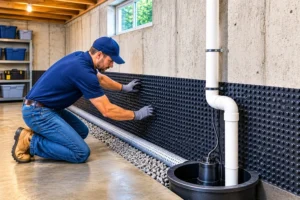
Water appearing repeatedly around the basement perimeter points to a different situation. In some homes, an interior drainage system is used to collect water and direct it toward a sump basin. A basement sump pump can then move the collected water away from the house.
But a sump pump is not a universal answer. It cannot correct an overflowing gutter or change the slope of soil outside a wall. And it does not make a poorly draining window well disappear.
The repair has to correspond to the route the water is actually taking.
What Should You Do the Next Time It Rains?
If the basement only leaks during storms, the next rainy day is a chance to collect useful information.
Photograph where the water first appears, not just where it eventually spreads. Look for a crack, a wet wall-floor joint, water running down a wall, or moisture collecting beneath a basement window.
Then go outside, if conditions are safe.
Are the gutters overflowing? Is a downspout releasing water a few feet from the wet area inside? Is water pooling beside the foundation instead of moving away?
Where runoff repeatedly collects, downspout and French drain solutions may be relevant when the problem is exterior water movement rather than pressure coming from beneath the basement.
Timing helps too. A leak that appears soon after rainfall begins may point toward a different route than seepage that develops only after hours of steady rain and saturated ground.
Those details can help show where the water is coming from and what may be causing the leak.
When Should You Call a Basement Waterproofing Professional?
Recurring water deserves a closer look when you cannot identify the entry point, when moisture repeatedly appears at foundation cracks or the wall-floor joint, or when an existing sump pump cannot keep up.
The same applies when standing water is returning or finished basement materials are getting wet more than once.
An inspection should answer a fairly specific question: how is water reaching the basement?
Sometimes the answer points toward a basement drainage or waterproofing system. In other cases, the more relevant problem is outside the basement, where rainwater is being collected or discharged.
If water keeps showing up in your basement after rain, it is worth finding the source before the problem gets worse. Sedona Waterproofing can inspect the area and recommend the right solution based on how the water is getting in.
Frequently Asked Questions
Why does my basement leak only during heavy rain?
Heavy rain can saturate the soil around a foundation and raise the amount of groundwater around or beneath the basement. Once enough water accumulates, it may find its way through cracks, joints, window wells, or other vulnerable areas that remain dry under ordinary conditions.
Can hydrostatic pressure cause basement leaks?
Yes. When groundwater builds up around or beneath a foundation, it can place pressure on basement walls and floors. Water may then move through available cracks, porous masonry, floor openings, or the joint between the wall and slab.
Can gutters and downspouts cause water in a basement?
They can contribute. Gutters or downspouts that discharge roof runoff beside the house can repeatedly concentrate water near the foundation. Moving that water farther away may reduce the amount reaching basement walls and the surrounding soil.
Will sealing a foundation crack stop basement water?
Sometimes, but only if the crack is the primary route the water is taking. If poor exterior drainage, groundwater pressure, or foundation movement is also involved, sealing the visible crack may deal with one symptom without correcting the larger condition.
Do I need a sump pump if my basement only leaks occasionally?
Not necessarily. A sump pump is useful when groundwater or a drainage system needs a dependable way to remove collected water. A leak caused by a window well, isolated crack, downspout, or grading issue may call for a different repair.