Your Crawl Space is Encapsulated. So Why is Water Still Getting in?
You pull back the crawl space door after a hard rain and see something you thought encapsulation was supposed to eliminate: water.
Maybe it is pooled on top of the liner. Maybe the vapor barrier looks dry, but you can hear or feel water moving underneath it. Or perhaps one corner of the crawl space stays wet every time several inches of rain fall.
That does not automatically mean the encapsulation has failed.
Crawl space encapsulation primarily controls moisture coming from exposed soil and humid outside air. It does not, by itself, stop groundwater, foundation seepage, poor exterior drainage, plumbing leaks, or a sump system that cannot keep up.
If water shows up in an encapsulated crawl space, the most common causes include poor grading and downspout drainage, rising groundwater, foundation seepage, inadequate interior drainage, sump pump problems, liner installation defects, and plumbing or HVAC leaks.
Encapsulation and Waterproofing Are Not the Same Thing
Crawl space encapsulation manages moisture, but it is not necessarily a complete water-management system.
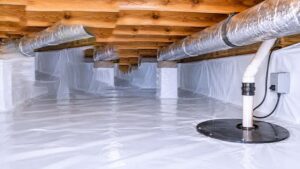
A typical encapsulation system separates the house from the damp earth below it. A heavy-duty vapor barrier covers exposed soil, seams are sealed, vents and air leaks may be closed, and a dehumidifier can be used to control humidity.
That works well for moisture vapor.
Liquid water is different.
If rainwater collects beside the foundation or groundwater rises beneath the house, that water needs a controlled path away from the crawl space. It may require perimeter drainage, a sump pump, exterior drainage corrections, or a combination of systems.
Encapsulation controls moisture at the surface, whereas waterproofing controls where liquid water goes.
And that is why a clean, professionally encapsulated crawl space can still develop standing water if the drainage problem underneath or around it was never fully addressed.
The 6 Most Common Reasons Water Gets into an Encapsulated Crawl Space
1. Groundwater is Rising Beneath the Crawl Space
After several hours or days of heavy rain, the soil surrounding a home can become saturated. As the groundwater level rises, water may move beneath the crawl space or push toward foundation openings and joints.
This is often described as hydrostatic pressure.
A homeowner may notice that the crawl space stays dry during a short thunderstorm but develops water after several consecutive wet days. It suggests the problem may be related to soil saturation or groundwater rather than water simply entering through an open vent.
When water collects beneath an encapsulation liner, the liner may actually make the problem less obvious because the entry point is hidden.
2. Gutters, Downspouts, or Yard Grading are Sending Water toward the Foundation
Sometimes the crawl space problem starts several feet away from the crawl space itself.
Consider a downspout that empties directly beside a foundation wall. During a strong storm, hundreds of gallons of roof runoff can be deposited into already wet soil. If the yard also slopes toward the house, that water has nowhere useful to go.
The result may be seepage along one side of the crawl space.
Clogged gutters, short downspout extensions, low spots beside the house, and negative grading should all be checked before assuming the encapsulation system itself is defective.
3. There is No Interior Drainage System, or it is Not Working
A vapor barrier does not transport groundwater.
Homes with recurring water intrusion may need an interior drainage system designed to collect water along the crawl space perimeter and direct it toward a discharge point or sump basin.
Without that path, water can spread beneath the liner and collect in low areas.
Sedona Waterproofing’s crawl space waterproofing process can include drainage systems, vapor barriers, sump pumps, and humidity-control equipment depending on what is actually causing the moisture problem.
If water repeatedly appears around the perimeter after rain, drainage should be one of the first systems inspected.
4. The Sump Pump Cannot Keep Up
Having a sump pump does not mean the drainage system is automatically working correctly.
A pump may fail because of a stuck float, loss of power, blocked discharge line, mechanical failure, or inadequate pumping capacity. The drainage system feeding the basin can also become restricted.
One common clue is water accumulating around the sump pit during storms.
If the pit fills faster than the pump can discharge water, the issue may be pump capacity. If the basin stays relatively empty while water appears elsewhere, the problem could instead involve how water is being collected and directed to the sump.
5. Water is Entering Through the Foundation
Water does not need a large foundation crack to get into a crawl space.
It can travel through cracks, masonry joints, penetrations around pipes, deteriorated mortar, and connections between foundation components. Water can also appear near the wall-to-ground junction when soil outside the foundation becomes saturated.
The water may show up in a different spot from where it first came in.
Water can travel behind or beneath an encapsulation liner before becoming visible several feet away. That is why simply sealing the spot where a puddle forms may not solve the original problem.
6. The Water is Coming From Inside the House
Not every wet crawl space is a waterproofing problem.
Plumbing lines, water heaters, HVAC condensate drains, appliance connections, and drainpipes can all leak beneath a home.
A small plumbing leak can be especially deceptive because it may continue during dry weather.
If one isolated section of the crawl space stays wet regardless of rainfall, the plumbing and mechanical systems above that area deserve a close look.
How to Tell Where the Water is Coming From
The timing and location of the water often provide useful clues.
| What You Notice | Possible Cause |
| Water after several hours or days of rain | Groundwater or saturated soil |
| Water concentrated near one exterior wall | Grading, gutter, or downspout problem |
| Water underneath the encapsulation liner | Groundwater or inadequate drainage |
| Water collecting around the sump basin | Pump, discharge, or capacity problem |
| One wet area during dry weather | Plumbing or HVAC leak |
| Seepage near cracks or masonry joints | Foundation water intrusion |
These patterns can narrow the possibilities, but they are not a substitute for an on-site inspection. Water can travel through soil, masonry, drainage stone, and beneath liners before becoming visible.
Should You Remove or Replace the Encapsulation?
Usually, not automatically.
If the liner is intact and properly installed, the encapsulation may still be doing exactly what it was designed to do: limiting ground vapor and separating the crawl space from exposed soil.
The unresolved problem may be underneath or outside that system.
Depending on the source, correcting the water intrusion could involve extending downspouts, improving grading, installing or repairing perimeter drainage, addressing foundation entry points, servicing the sump pump, or adding backup pumping capacity.
Sections of the liner may need to be temporarily opened or repaired to access drainage components. That is different from assuming the entire encapsulation system needs replacement.
What a Crawl Space Waterproofing Inspection Should Check
A useful inspection starts with water.
The inspector should look at where moisture is appearing, whether the pattern changes after rain, and whether water is above or beneath the liner. Foundation walls, penetrations, liner seams, attachment points, sump equipment, drainage channels, grading, and downspout discharge should all be considered.
Plumbing and HVAC components should also be checked when the moisture pattern does not correspond with rainfall.
When it comes to crawl space care, Sedona Waterproofing emphasizes looking for pooling water, cracks, hidden moisture near mechanical equipment, and other signs that can help identify how water is entering the space.
The goal is to identify the source before deciding on the repair.
The Bottom Line
If water is getting into an encapsulated crawl space, it does not necessarily mean the encapsulation failed.
More often, it means liquid water is reaching the crawl space through a route the encapsulation was never designed to control. Groundwater, exterior drainage, foundation seepage, sump problems, and plumbing leaks all require different responses.
Before replacing a liner or adding equipment, determine where the water originates and how it should be collected and removed.
For homeowners dealing with recurring crawl space water, Sedona Waterproofing can inspect the existing encapsulation and water-management system to identify the source before recommending repairs.
Frequently Asked Questions
Is it normal to have water under a crawl space vapor barrier?
Recurring or standing water beneath a vapor barrier should be investigated. It may indicate rising groundwater, poor drainage, runoff entering near the foundation, or another liquid-water source that the vapor barrier itself cannot remove.
Can water come through a crawl space foundation wall?
Yes. Water can enter through foundation cracks, masonry joints, penetrations, deteriorated mortar, or connections between foundation components when surrounding soil becomes saturated.
Does crawl space encapsulation include a sump pump?
Not necessarily. Encapsulation and active water drainage perform different jobs. A sump pump may be incorporated into a crawl space waterproofing system when site conditions require collected groundwater to be pumped away from the foundation.